
Business model design is how you work out whether a useful idea can also become a viable business. Because customers loving the idea is only one part of the story.
A business model explains how a business creates value for customers, delivers it and gets enough value back to keep going. Business model design is the work of shaping and testing those connected choices.
It is not a single pricing decision, and it is not a document you complete once and admire from a safe distance.
The Inspiration Space view: A business model should serve the person operating it as well as the customer. It should not become a rescue mission for a favourite idea.
Why it matters
A good offer can still sit inside a bad model. Perhaps the buyer is hard to reach, delivery swallows the fee, or every sale creates more custom work than the last.
Business model design helps you spot those tensions early. Change one part and the others may move too. A cheaper offer may need simpler delivery; a new customer may need a different sales route. Nothing lives in splendid isolation.
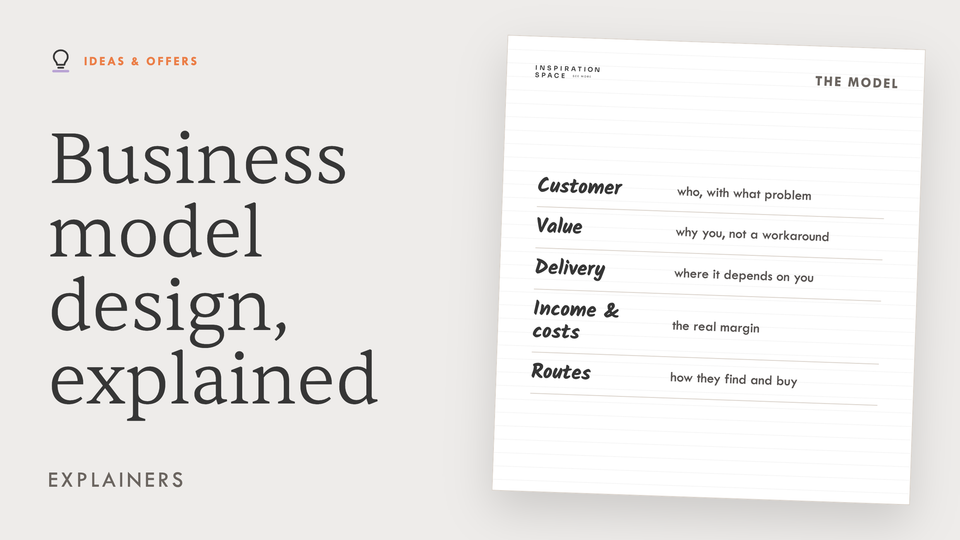
What makes up a business model?
Customer and problem
Who are you helping, and what are they trying to change? “Small businesses” is too broad. Be specific about the kind of business, the person you need to reach and the problem they are trying to solve.
Value proposition
Why might this customer choose your offer over their current workaround, another provider or doing nothing?
Delivery
What people, activities, tools and partners are needed to produce the promised result—and where does the model depend on you personally?
Income and costs
What does the customer pay for, how often, and what does it really cost to sell and deliver? Revenue can look impressive while the margin quietly packs a bag.
Routes to customers
How will the right people discover, assess and buy? The best route fits the customer’s behaviour, not the platform currently shouting loudest.
The wider environment
Your model also sits inside a changing world. Regulation, technology, competitors, costs and customer expectations can turn yesterday’s sensible choice into today’s expensive habit.
What this looks like in practice
An HR specialist thinks growing firms need a management programme. That is a hunch, not yet a model.
They interview founders and recently promoted managers about the last people decision that got stuck. They find that generic training already exists; the harder problem is practising difficult conversations safely before trying them at work.
Instead of building a full programme, they sell a small diagnostic and one live case session. They watch who pays, who attends, which cases recur and how much preparation delivery takes. Only then does she test a limited pilot with a defined buyer, result, format and price.
The evidence may show that you can offer the same kind of help to several clients.
Or it may show that every piece of work needs a different approach. Both are useful things to know — even if the second answer is not what you hoped for.
A business model is not a rescue mission for your favourite idea
Starting with the solution and forcing every other choice to justify it. A business model is a system of choices, not a rescue mission for your favourite idea.
Use the related Guide to map your current model, identify the assumption most capable of breaking it, and design the smallest credible test. If every part looks plausible but the whole still does not add up, Borrow my Brain. Bring the model, the evidence and the knot you keep circling; leave with a clearer frame and next moves. 90 minutes · £350 + VAT.
Related Resource
Business Model Design Guide