
Three numbers that decide whether the month worked, and how to read them without a finance degree.
Why these numbers matter
A £10,000 month can sound magnificent while the business is still short of usable cash.
A client may not have paid. Part of the balance may belong to subcontractors, HMRC or next month’s bills.
Revenue shows sales. Profit shows whether income exceeded costs. Available cash shows what the business can afford now.
The first question is: how much of the cash is already spoken for?
How the three numbers work
Revenue
Revenue—often called turnover—is business income before expenses.
An invoice raised this month may be paid next month, so revenue and cash received are not always the same.
Revenue tells you about sales. It does not tell you whether you made money from them.
Profit
Profit is revenue minus the relevant business costs.
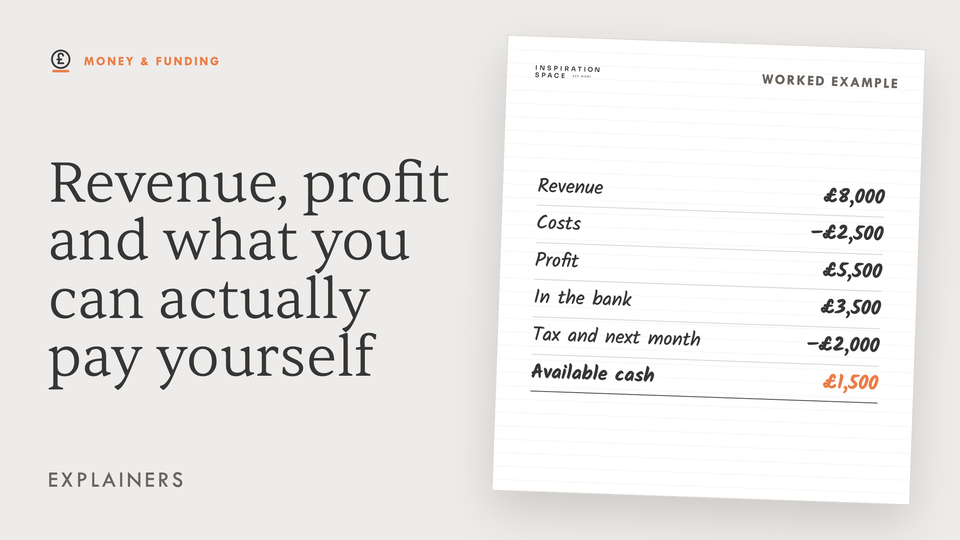
£8,000 of revenue minus £2,500 of costs gives £5,500 of simple profit.
Accountants use several profit figures. Check that the one you are reading includes the ordinary costs of running and delivering the work.
Available cash
Available cash is not a formal line in your accounts. It is the part of your bank balance that is not already spoken for.
Allow for unpaid bills, tax, VAT where applicable, debt repayments, upcoming commitments and a buffer. What remains is a more realistic owner-pay figure.
What can you pay yourself?
If you are a sole trader
You and the business are not legally separate. Money you take for yourself is normally recorded as drawings rather than a business expense.
The important catch is that you are generally taxed on the business’s profit, not simply the amount you withdraw. Emptying the account does not empty the tax bill. GOV.UK explains that sole traders keep their profits after tax and pay Income Tax based on their profits.
If you run a limited company
The company’s money is not automatically yours, even if you are its only director and shareholder.
Money normally leaves through salary, dividends, expense repayments or a director’s loan. Dividends can only be paid from available company profits, while other withdrawals may need to be recorded as loans and repaid. GOV.UK explains the rules for taking money from a limited company.
What this looks like in practice
A sole-trader consultant generates £8,000 in revenue and incurs £2,500 of costs, leaving £5,500 profit.
Only £6,000 has reached the bank because one client still owes £2,000. After paying costs, £3,500 remains.
She reserves £1,200 for tax and £800 for next month’s commitments. Available cash: £1,500.
A profitable month, but not £5,500 she can safely take.
The bank balance is not your pay packet
The common mistake is to treat money in the account as spare money.
Some belongs to HMRC or upcoming bills. Some may be needed to deliver work already sold. The banking app does not know that.
A healthy business pays its owner without leaving the business unable to do its job.