If your marketing relies on words such as “green”, “environmentally friendly” or “climate neutral”, September comes with homework.
New EU rules designed to tackle misleading environmental claims begin applying on 27 September 2026.
And, before somebody starts confidently referring to “the Green Claims Directive”, this is where we need to separate two pieces of legislation that are frequently bundled together.
What has actually changed
The rules taking effect this month come from the EU’s Directive on Empowering Consumers for the Green Transition.
EU countries were required to transpose it into national law by 27 March 2026. Those national rules apply from 27 September.
The separate Green Claims Directive proposed more detailed requirements for substantiation and independent verification.
Its legislative process stalled in 2025 and its future remains uncertain.
Don't wait for that proposal to be resolved before checking your copy.
What the new rules prohibit
The directive adds several practices to the EU’s list of commercial practices that are considered unfair.
They include:
- using generic environmental claims without being able to demonstrate recognised excellent environmental performance;
- making an environmental claim about an entire product or business when it only applies to one part;
- claiming that a product has a neutral, reduced or positive greenhouse-gas impact when that claim is based on offsetting emissions; and
- displaying sustainability labels that are not based on a certification scheme or established by a public authority.
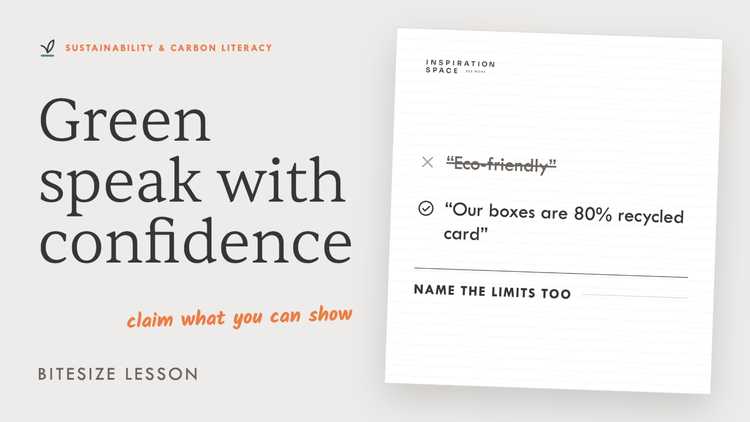
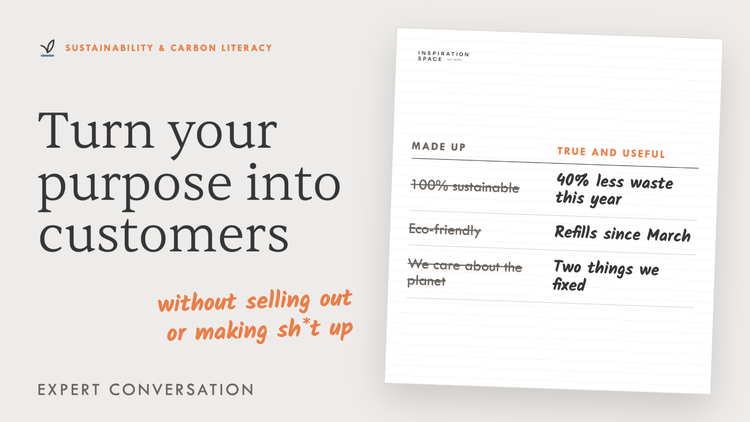
In practical terms, a vague claim such as “green choice” now carries far more risk than a specific statement explaining what changed, what was measured and what the evidence covers.
Who needs to pay attention
This matters to businesses selling products or services to consumers in the EU - including UK businesses serving that market.
It also matters to the people producing the words and images: founders, marketing teams, copywriters, designers, agencies and anybody approving product pages, packaging or advertising.
“The client gave us the wording” is not much of a claims-checking process.
What to do before 27 September
Search your website, adverts, product descriptions, packaging and campaign templates for broad environmental language.
For every claim, ask:
- What exactly are we saying?
- Does it describe the whole product or one feature?
- What evidence supports it?
- Could an ordinary customer understand the limitation?
- Are we relying on carbon offsets to imply that a product has no climate impact?
If the claim is broader than the evidence, narrow it.
If nobody can find the evidence, remove it until they can.
Talking about genuine environmental progress matters more now than ever. You can help accelerate progress and trust by being clear and direct about the work.
Sources
European Commission: sustainable consumption and the September 2026 application date