
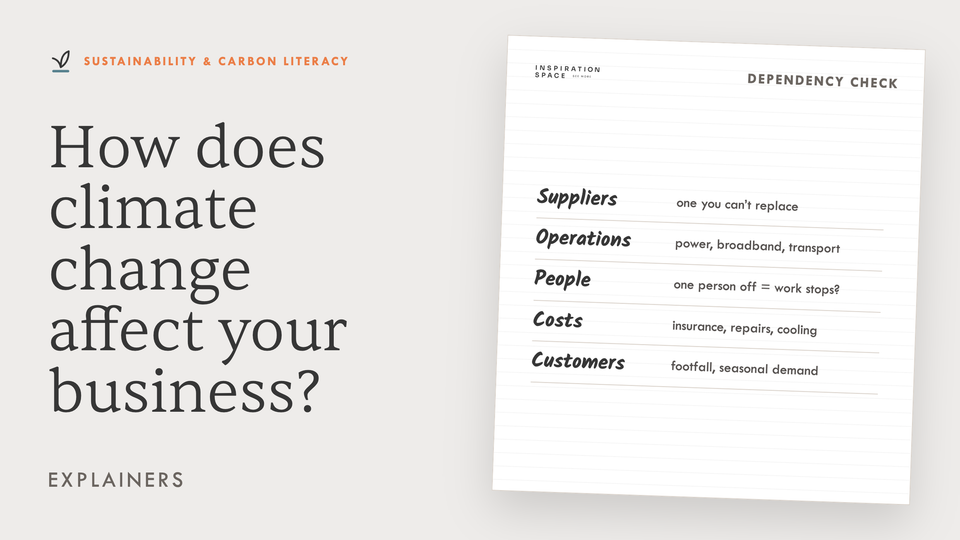
See where climate risk could affect your suppliers, operations, people, costs and customers.
Climate change can disrupt a small business through heat, flooding, storms or water shortages. It can also affect the people, suppliers and systems the business relies on.
Think about the things your business needs to keep operating: a key supplier, reliable internet, a workspace, transport or certain staff. If one of those was disrupted by extreme weather, what would make it hard for you to carry on?
The Inspiration Space view: Climate risk becomes a business problem when disruption affects something you need to keep working. Identify those dependencies first.
Why does this matter?
In August 2026, climate risk has been unusually visible. Copernicus reported that western Europe experienced its warmest June–July period on record.
On 11 August 2026, the Met Office said the UK was increasingly likely to record its warmest summer, while making clear that the meteorological summer was still under way.
The business issue lasts beyond one hot season.
Risk matters when an essential dependency is difficult to replace and disruption travels quickly.
The UK Climate Change Risk Assessment identifies risks to food, goods and vital services from climate-related disruption to supply chains and distribution networks.
For a small business, the useful question is not every possible hazard. It is: what could be disrupted, and how badly would that affect my ability to work?
How can climate risk reach a business?
The Met Office expects the UK to experience warmer, wetter winters, hotter, drier summers and more frequent or intense weather extremes.
Those changes can reach a business through five connected areas.
Suppliers
Heat, drought, flooding, storms and wildfires can affect ingredients, materials, stock and components. Look for a supplier or service you could not replace quickly.
The affected organisation may be several links away, so the first sign could be a delay or higher price.
Operations
Flooding can damage premises or stock. Heat can disrupt a workplace. Storms can interrupt power, broadband, transport and deliveries.
An online business still depends on physical infrastructure somewhere.
People
Extreme conditions can affect concentration, working arrangements, travel and caring responsibilities.
Ask whether the work stops when one person or specialist contractor is unavailable.
Costs
Climate risk can reach the accounts through supplier prices, cooling, insurance, repairs, transport, cancelled work or lost trading time.
Which unexpected cost would be hardest for the business to absorb?
Customers
Weather can change footfall, events, deliveries, seasonal demand and whether customers can use what you sell.
It may create new needs, but those still require evidence. A heatwave is not permission to invent a market.
What might this look like in practice?
Consider a two-person consultancy running a client workshop. Severe weather closes the rail line, the venue loses power and its freelance facilitator cannot travel. The client postpones.
It suffers no physical damage, but loses non-refundable costs and the final payment moves into another month.
The exposure came from what the work depended on, not its size.
Climate risk is not limited to high-emission businesses
The common mistake is assuming climate risk belongs to farms, manufacturers or companies with visibly large emissions.
Reducing emissions and preparing for disruption are connected, but they are not the same task. Nor does every flood or heatwave prove, by itself, that climate change caused it.
This Explainer is about adaptation: finding where changing conditions could interrupt the business and making that dependency less fragile.
Choose one thing your business could not easily operate without, such as a key supplier, workspace, transport route or member of staff.
Ask: could heat, flooding, drought or storms disrupt it? If so, identify one realistic backup — another supplier, a different way of working or a plan for moving work.
If flooding could affect your premises, check the government’s long-term flood-risk service for England. Scotland, Wales and Northern Ireland have separate services.
Read Climate Crisis Hits Home for an example of how drought affected Freixenet’s grape supply, production and working hours.
Sources
- Copernicus: Western Europe’s record June–July period
- Met Office: Warmest UK summer increasingly likely
- Met Office: Climate change in the UK
- UK Government: UK Climate Change Risk Assessment 2022
- Climate Change Committee: Climate risk to UK supply chains
- GOV.UK: Check the long-term flood risk for an area in England