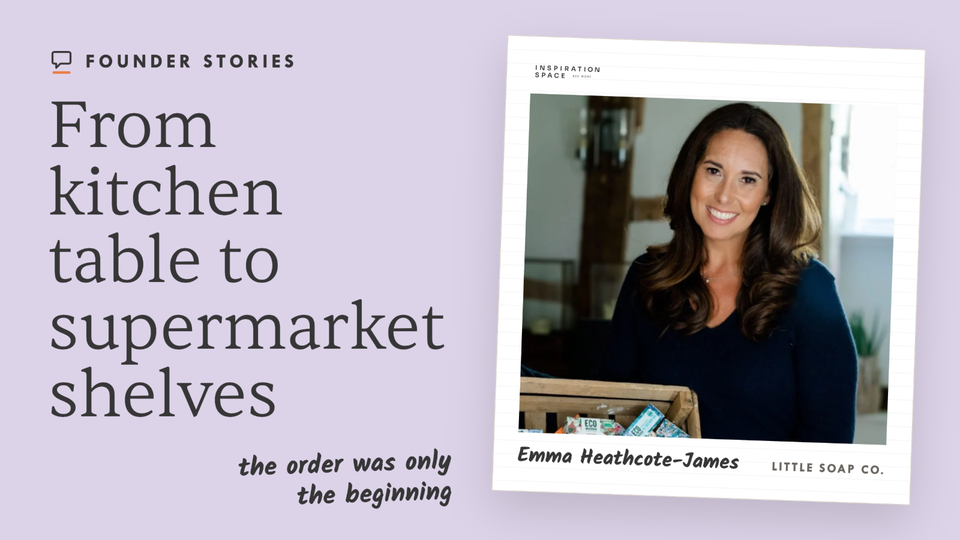
Emma Heathcote-James spent years trying to get her soap into Waitrose. When she finally built an exclusive range for the retailer, a factory shortfall left hundreds of thousands of pounds—and, in her words, her house—on the line.
It began as a hobby, not a business plan
Emma began making soap because it reminded her of the bars her grandmother brought home from her travels. When she found little resembling them in supermarkets, she tried making her own.
“It started as a hobby business that accidentally grew,” she said. “I’d love to sit here and say I found a gap in the market. No. It was a hobby business that went wrong.”
Her first attempts crumbled. A chance meeting with an experienced soap maker helped her identify the problem with the oils, and Emma later bought the maker’s recipes. She had no retail experience, but she decided the finished bars belonged on supermarket shelves—particularly Waitrose.
Twelve barcodes got her into her first retailer
Waitrose did not answer Emma’s emails, so she approached a smaller local supermarket group. Its buyer liked the soap but told her to return when she had more experience and proper barcodes.
Emma joined GS1 for £250 and received 12,000 barcode numbers when she needed only 12. She printed the ones she needed on a single sheet, cut them out with kitchen scissors and returned to the buyer.
She held a newly labelled bar against the window of his office while he was in a meeting. The soap gained its first retail listing.
The orders were modest: perhaps 12 or 24 bars a month from each store. Farmers’ markets, events and local businesses provided other small opportunities. Emma was learning that reaching a retailer did not automatically produce meaningful volume.
Waitrose gave her credibility, not profit
Emma continued pursuing Waitrose. After her emails and samples went unanswered, she drove to its headquarters and waited for two and a half hours without an appointment.
The buyer did not believe such a new business could supply the whole chain. Emma explained that she only wanted one local store. The compromise was a listing in eight stores, with Emma responsible for making the soap and delivering every order.
“I was making a complete loss if you added my time, the driving and the petrol,” she said. “But I was in Waitrose.”
She kept the arrangement going for roughly 12 to 18 months because the retailer’s name changed how others regarded the business. Saying that she made soap attracted polite interest. Saying that it was stocked by Waitrose made people listen.
The listing was therefore doing a different job from producing profit. It gave the young company credibility and evidence, but Emma was paying for that benefit through her own time, petrol and unpaid labour.
Tesco changed how the soap was made
Handmaking also placed a ceiling on the business. Emma estimated that she could produce about £40,000 worth of soap a year herself. Employing other people to make it would change the margins, and continuing alone was exhausting her.
At a conference, one woman challenged Emma’s belief that natural soap belonged in Waitrose. If Emma wanted to make it accessible to more people, why had she never approached Tesco, where one in three people shopped?
The woman was a Tesco buyer. She visited Emma a week later and placed an order for 40,000 bars.
Emma could not make the order herself. She needed a factory, but factory machinery could not use the handmade recipe unchanged. The formula had to be adjusted while retaining the qualities that mattered.
Then the invoice arrived. Emma did not have the money to pay for the production upfront or after 30 days. She argued that this was not speculative stock: Tesco was a confirmed customer and the manufacturer could be paid when Tesco paid her.
The factory’s directors agreed. One described it as either “a moment of madness or a moment of genius”. The Tesco order gave Emma the evidence needed to negotiate, but it also moved The Little Soap Company into a business model with larger commitments, longer payment chains and more money exposed to decisions elsewhere.
Winning Waitrose nationally created a new problem
The Tesco launch led to national opportunities with Waitrose and other major retailers. Yet getting into more stores did not make any listing permanent.
A new Waitrose buyer saw a product that was now available elsewhere and questioned why it deserved its place. Unless Emma could offer something different, the range could be delisted.
Emma responded by creating an exclusive lavender and rose geranium range for Waitrose within six months. It was the kind of opportunity she had spent years trying to win: a product developed specifically for her dream retailer.
It also concentrated the risk. When the factory warned that it would have to short the first order, Emma believed Waitrose might reject the delivery.
“My house was on the line,” she said. She had hundreds of thousands of pounds tied up in the order and spent the weekend fearing that the buyer would be furious.
After leaving the buyer a panicked message, Emma received a call that evening. Before realising who was speaking, she poured out the whole story. The buyer calmly explained that short orders happened and the delivery would still be accepted.
For Emma, the incident felt like a possible threat to the business and her home. For the retailer, it was an ordinary supplier problem. The difference between those two views revealed how much risk sat with the smaller company—and how little Emma yet knew about which problems were truly catastrophic.
Retail growth remained a negotiation
The same pattern appeared again when Eco Warrior was developed for Sainsbury’s. The planned rollout was reduced after the buyer changed jobs, leaving Emma with stock made for far more stores than the eventual listing covered.
Sainsbury’s adjusted the exclusivity agreement so the company could sell the range through other retailers. A product created for one route to market had to find several others.
These were not simply marketing wins followed by smooth growth. Each retailer brought its own requirements, buyer changes, exclusivity decisions, production commitments and payment timings. A listing could create credibility and volume while making the company more exposed.
The business had to grow beyond Emma
Emma’s caution around money also delayed hiring. She later recognised that some early employees were right for the smaller company but did not want to build at the scale she imagined.
“I never wanted it just to be a small business,” she said. “Have people who want that scale and will run alongside that vision.”
By the time we spoke, The Little Soap Company had built a core team supported by freelancers, consultants and agencies. The company no longer stopped functioning when Emma went away. Scaling meant distributing knowledge and responsibility as well as increasing production.
Watch the interview
[Embed the full video interview with Emma Heathcote-James here]
A dream client can still be the wrong kind of success
Since the interview, The Little Soap Company has continued to develop new products, retained its B Corporation certification and received national recognition for innovation and sustainable development.
Those polished outcomes do not make the route towards them tidy. Waitrose gave Emma the legitimacy she wanted, but the relationship initially cost her money. Keeping the listing required an exclusive range. Fulfilling that range placed a substantial amount of money—and, as Emma understood it, her house—at risk.
Her experience does not suggest that small companies should avoid large customers. It shows why the customer’s name and headline order value are not enough to judge an opportunity.
If one customer changed its plans, delayed payment or rejected an order, what would happen to the business behind your offer?
Related resource
Business Model Design: Explained
A new customer or sales channel can change more than revenue. Use this Explainer to examine what the opportunity would require from your production, partners, costs and cash