Sustainability used to arrive in the marketing department as a special campaign.
There would be a launch, a pledge, several leaves and possibly a stock photograph of somebody holding a seedling.
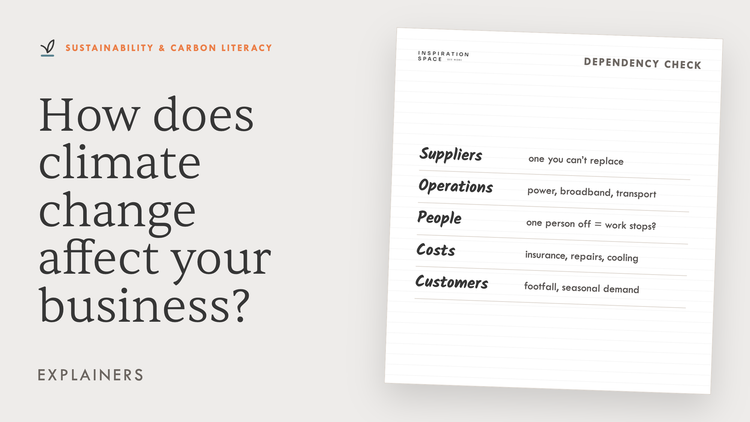
For some businesses, that work now sits inside product development, procurement, operations, finance and reporting.
It's becoming part of how the company works rather than a yearly moment in the content calendar.
That changes the marketer’s job.
There's no need to panic at the disco - you don't need to become a climate scientist.
But, you DO need enough knowledge to understand the brief, question the claim and recognise when you are being asked to communicate something the business cannot support.
Why it matters
The distance between what a business does and what its marketing says is becoming harder to hide.
Regulators are paying attention. Customers can find the contradiction. Employees may already know where the uncomfortable bits are buried.
The answer is not to cover every campaign in disclaimers or stop talking about environmental decisions altogether.
It's to build better judgement into the work.
The skills marketers need
Understand the language
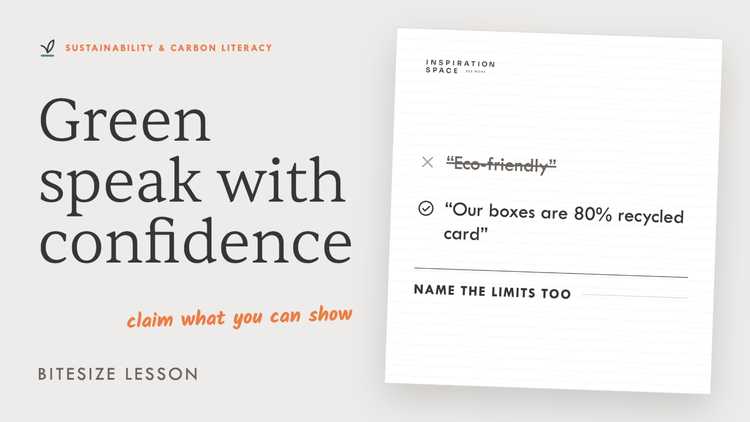
Carbon neutral, net zero, recyclable, recycled, renewable, circular and sustainable are not interchangeable decorative adjectives.
You should know what a term means, what it refers to and what evidence would normally be needed to support it.
Ask where the evidence came from
A supplier statement is information - not necessarily proof.
Ask who produced the evidence, what was measured, which parts of the product or business it covers and whether anything important has been left outside the frame.
Spot the difference between progress and perfection
A business can talk honestly about improving one part of its work without presenting itself as the finished answer to climate change.
Specific progress is more credible than an enormous promise with a suspiciously tiny footnote.
Understand the impact of the marketing itself
Campaigns use energy, materials, money and human attention.
That includes digital advertising, websites, email, print, events, packaging, photography and video.
The useful question is not whether digital or print is universally “better”.
It's whether the activity is earning its place.
Know when to stop and ask an expert
Marketing skill includes recognising the edge of your own expertise.
If a claim depends on technical environmental data, legal interpretation or a full product assessment, bring in somebody qualified to check it.
Don't fill the gap with an enthusiastic adjective.
What to do next
Choose one environmental claim your business or client currently makes.
Can you explain it plainly?
Can you find the evidence?
Does the wording match what the evidence actually proves?
If any answer is no, you have found your next piece of work.
That, my friend, is sustainability becoming business as usual: fewer theatrical promises, better questions and claims that can survive contact with reality.
Sources