Venture capital is a form of equity finance. An investor puts money into a business in exchange for a share of its ownership.
It is usually aimed at privately owned businesses with strong potential for rapid growth.
The company gains capital to develop and expand; the investor hopes their stake will become more valuable over time.
Unlike a loan, venture capital does not usually come with scheduled repayments.
The investment is made in return for equity, and the investor generally expects to realise a return through a future sale, stock-market listing or another transaction.
Reviewed: August 2026
1. Where does venture capital money come from?
A venture capital firm typically manages a fund made up of money committed by its own investors.
Depending on the fund, those investors might include pension funds, financial institutions, family offices, government-backed programmes, universities or wealthy individuals.
The VC firm invests that pooled money across a portfolio of companies. It does not expect every investment to produce the same result.
The aim is for the portfolio as a whole to generate a return for the fund’s investors over time.
This structure helps explain why venture capital firms look closely at the size of a potential market and how quickly a company might grow.
2. How does a VC investment work?
The basic exchange is capital in return for equity.
Before investing, the VC will usually examine the company, its finances, product, market, team and growth potential. If both sides want to proceed, they negotiate the investment terms.
The company’s valuation helps determine how much ownership the investor receives for their money.
When new shares are issued, the percentage owned by existing shareholders may fall. This is known as dilution.
VC investment may also bring investor involvement. Depending on the deal, an investor might receive information rights, voting rights or a seat on the board.
The precise arrangement is set out in the investment documents.
The investor usually makes money when there is an exit.
This might happen if the company is acquired, lists its shares through an initial public offering (IPO), or the investor sells its stake to another buyer.
An exit is never guaranteed.
3. Why do VCs look for rapid growth?
Venture capital funds are shaped by power-law economics. Some portfolio companies may fail, return little or grow more slowly than expected.
A much smaller number of successful investments may generate a large proportion of the fund’s total returns.
This is why VCs often look for businesses capable of becoming significantly larger. A company needs the potential to produce an outsized result that can materially affect the performance of the wider fund.
There is no universal target multiple that applies to every investor or company.
Expectations vary according to the fund, investment stage, sector, risk and the price paid for the equity.
4. What are the main stages of venture capital funding?
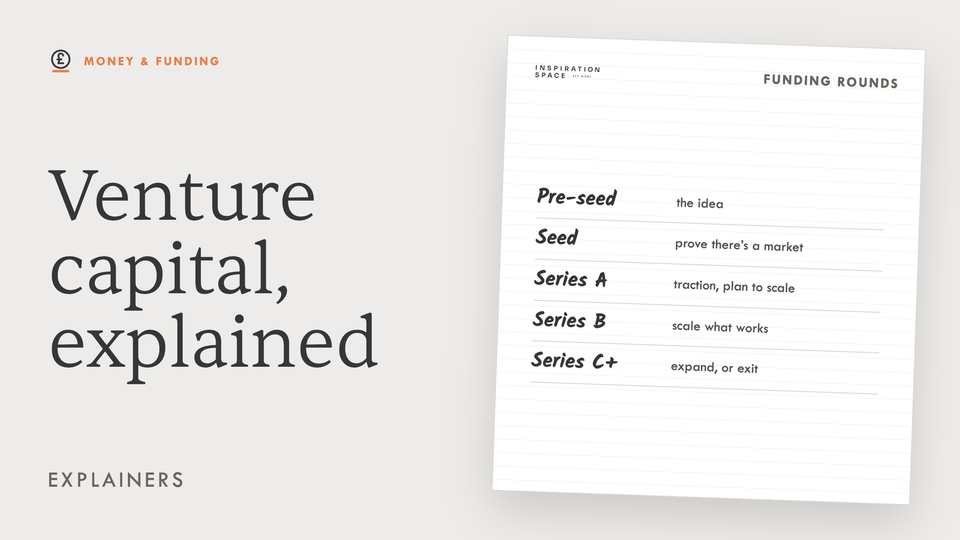
Venture funding often arrives through a series of fundraising rounds.
The names are useful shorthand, although they do not have universally fixed definitions and companies do not all follow the same sequence.
Pre-seed
Pre-seed finance supports an early idea, product development or initial testing.
Institutional VC is less common at this point. Funding may come from the founders, friends and family, angel investors, accelerators or grants.
Seed
Seed funding helps turn an idea into a functioning business.
It may be used to develop the product, test demand, conduct market research, build a team or demonstrate that there could be a viable market.
Series A
Series A usually takes place once there is stronger evidence of traction and a credible plan for scalable growth.
The funding might support hiring, operations, product development and customer acquisition.
Series B
Series B is generally focused on scaling a model that has already demonstrated meaningful traction.
A company may expand into new markets, strengthen its infrastructure or add products and people.
Series C and later
Later rounds often support substantial expansion, acquisitions, new products, entry into additional markets or preparation for a possible exit.
The British Business Bank’s guide to equity funding stages provides further detail.
In practice, the amount raised and what a round is called depend on the company and the market.
5. VC jargon worth knowing
- Equity — ownership in a company.
- Valuation — the value assigned to the company for the purpose of an investment.
- Dilution — the reduction in an existing shareholder’s percentage ownership when new shares are issued.
- Cap table — the record of who owns what percentage of the company.
- Term sheet — the headline terms proposed for an investment.
- Exit — an event through which investors may realise a return, such as an acquisition or IPO.
- Fundraising round — a period in which the company raises a particular tranche of investment.
VC is one way to finance a business
Venture capital is one source of business finance. Other routes include revenue, grants, loans, crowdfunding, angel investment and bootstrapping.
Each works differently and may be relevant at a different point in a company’s development.
Understanding how VC works is the first step.
The next question is whether its economics and expectations make sense for the business you’re building.
Read the companion Resource: Should I raise venture capital for my business?