
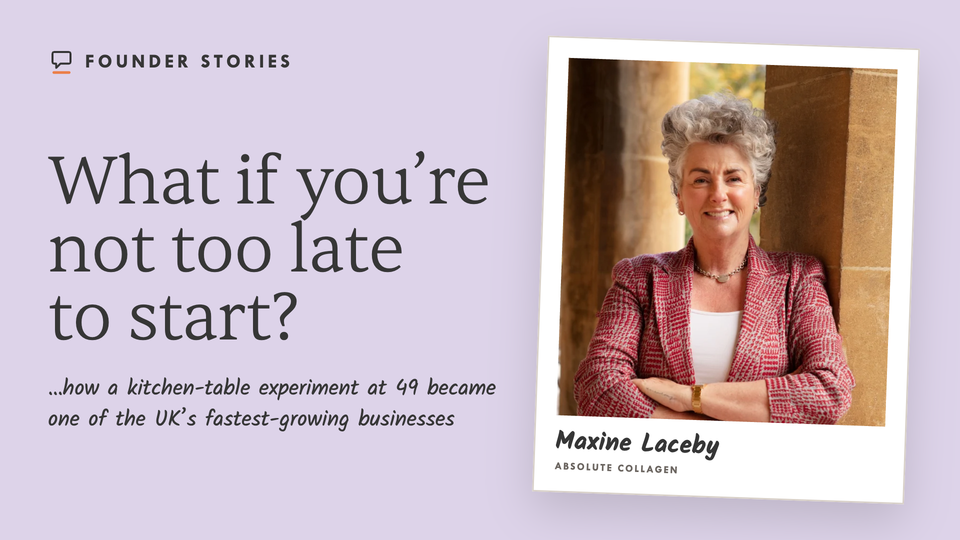
Maxine Laceby started Absolute Collagen at her kitchen table after beginning a fine art degree at 49. In our conversation, she shared how she developed a product, risked her own money and learnt when to slow customer acquisition so the business could keep up.
The big idea
After more than two decades as a stay-at-home mother, Maxine found herself asking what she wanted to do next. Her daughters were growing up, and she enrolled on a fine art degree in Wolverhampton.
At around the same time, she began making bone broth and researching the collagen it contained. Her curiosity led to experiments and eventually a marine collagen product designed for everyday use.
Maxine found existing products expensive and inconvenient to carry. She wanted a pre-mixed serving that could be kept in a handbag or desk drawer without refrigeration.
She researched suppliers, spoke to scientists and sought guidance from food standards officials.
“It was never, ‘This is a great business idea. I’m going to make lots of money,’” she told me. “It was always a solution: we can fix this; we can do this.”
The turning point
Getting a product to market meant committing to minimum orders for ingredients, blending and sachets.
Maxine believed she needed to give the business at least a year and spoke to her daughters about the consequences if it failed: the family might need to sell their home and buy a smaller one.
She used money set aside to repay a mortgage, borrowed from friends and sold personal possessions. She took little from the company and reinvested its profits.
Maxine was clear about the circumstances that made that possible.
“I was in a fortunate position and I’m not going to pretend I wasn’t,” she said. Her children were grown up and the family already owned a home.
How she built it
Maxine worked with external manufacturers and initially outsourced fulfilment.
She later brought packing and dispatch home because she felt the arrangement had put distance between the business and its customers.
She also sought expertise she did not have herself. With no background in digital marketing, she found a specialist and persuaded her to work with the business.
Then, Maxine said, she had to trust her to do the job.
“I had to have the confidence to hand her the reins and go, ‘This is your bag.’”
By one stage, eight people were dispatching thousands of parcels from her garage. As revenue passed new milestones, Maxine asked the marketing team to stop acquiring customers while she checked that the systems were ready to support them.
The business later sought investors for strategic support as well as money.
Maxine told me the team chose people it believed would listen and respect its values, rather than simply accepting the highest offer.
Food for thought
A few things in Maxine’s story are worth thinking about:
- More customers create more work. Marketing, fulfilment and customer service need enough capacity to keep pace with demand.
- Asking for expertise can help you make decisions outside your experience. Giving someone responsibility also means making room for them to use it.
- Before committing personal money, consider the potential downside and the people who would share it.
What would tell you that your team or systems need attention before you bring in more customers?
What may not transfer
Maxine had access to personal funds, a family home and support from her children and friends.
Her children were grown up when she made the financial commitment. Those circumstances affect the risks she could take and will differ for other founders.
Maxine's decisions about manufacturing, fulfilment and investment responded to the needs of a physical product business at particular stages.
Another business may need a different mix of people, partners and processes.
Listen to the full conversation
Hear Maxine discuss starting Absolute Collagen, asking for help and managing growth in “Bet on Yourself”, an episode of Unfinished Business.
Keep Exploring
How a dream client almost broke The Little Soap Company
A major customer can open doors, but a big order can also put pressure on a small business. Explore what happened when The Little Soap Company had to work out how to deliver on an opportunity. Explore the story in the Library.
 Liana Fricker
How to pitch your business with confidence
Maxine had to explain her idea to suppliers, specialists and investors. Use this guide to create a clear, buyer-focused pitch for your own offer and adapt it to the conversation. Get the guide in the Library.
 Inspiration Space

Clare Yarwood-White
Maxine knew where she needed other people’s expertise. If you need help explaining what makes your business distinctive, Clare Yarwood-White offers brand strategy and writing for creative businesses. Explore Clare’s Directory listing.
 Inspiration Space